Read more ↓
Messaggi
2026
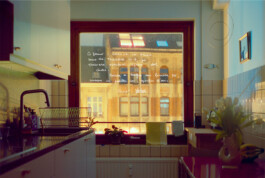
The series Messaggi portrays a domestic environment: the first home Nicoletta Grillo lived in after moving to Brussels. In that house, where the windows had no shutters and hardly any curtains, light entered unfiltered, and the gaze gradually became familiar with its behaviour, its cycles and rhythms, and the way it illuminated spaces and objects throughout the day.
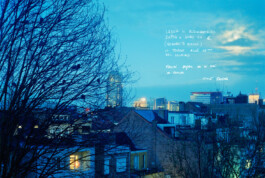
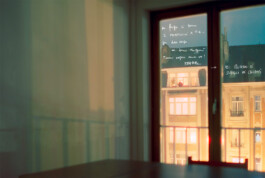
The photographed windows bear handwritten texts inscribed on the glass by the artist, who carefully traced her mother's handwriting. These texts are recompositions of phrases drawn from a diary in which her mother, before leaving for work in the morning, would leave messages for family members who were still asleep. They are instructions related to household management and meals, traces of affection but also of the forms of care work historically assigned to women, within a labour time that extends far beyond the hours of paid employment.
The photographs depict the kitchen and the table around which meals are shared, while through the windows the gaze opens onto the outside world at an indeterminate moment between night and day. It could be early morning, at dawn before sunrise, or the end of the day in the hour before nightfall. On one side, the windows overlook the street and the houses opposite; on the other, an inner courtyard with trees, where birds dwell at eye level against the backdrop of newly built high-rise towers. Other illuminated windows, surfaces connecting interior and exterior, point toward other interiors and other lives unfolding in the early morning or evening hours.
The illuminated window thus becomes a symbolic element of this time “before:” the time spent inside the home, this intermediate state between sleep and work which, for many women, is still work. In the light of dawn or dusk, which imprints the image onto photographic film, the words seem almost to have been written by that very light. They emerge through different stages of a material, manual process in which Grillo repeatedly traced the phrases, practising them many times before writing them on the glass of the photo frame. Through this repetition, she gradually came close to acquiring her mother's handwriting as her own.
Text by Carlo Caccamo
Messaggi
2026
The series Messaggi portrays a domestic environment: the first home Nicoletta Grillo lived in after moving to Brussels. In that house, where the windows had no shutters and hardly any curtains, light entered unfiltered, and the gaze gradually became familiar with its behaviour, its cycles and rhythms, and the way it illuminated spaces and objects throughout the day.
The photographed windows bear handwritten texts inscribed on the glass by the artist, who carefully traced her mother's handwriting. These texts are recompositions of phrases drawn from a diary in which her mother, before leaving for work in the morning, would leave messages for family members who were still asleep. They are instructions related to household management and meals, traces of affection but also of the forms of care work historically assigned to women, within a labour time that extends far beyond the hours of paid employment.
The photographs depict the kitchen and the table around which meals are shared, while through the windows the gaze opens onto the outside world at an indeterminate moment between night and day. It could be early morning, at dawn before sunrise, or the end of the day in the hour before nightfall. On one side, the windows overlook the street and the houses opposite; on the other, an inner courtyard with trees, where birds dwell at eye level against the backdrop of newly built high-rise towers. Other illuminated windows, surfaces connecting interior and exterior, point toward other interiors and other lives unfolding in the early morning or evening hours.
The illuminated window thus becomes a symbolic element of this time “before:” the time spent inside the home, this intermediate state between sleep and work which, for many women, is still work. In the light of dawn or dusk, which imprints the image onto photographic film, the words seem almost to have been written by that very light. They emerge through different stages of a material, manual process in which Grillo repeatedly traced the phrases, practising them many times before writing them on the glass of the photo frame. Through this repetition, she gradually came close to acquiring her mother's handwriting as her own.
Text by Carlo Caccamo